

The Employee Savings Socially responsible range
 The range of HSBC socially responsible FCPEs
At HSBC, we offer a socially responsible employee savings range designed for savers who want to contribute to a more responsible economy. This range spans all asset classes (money market, bonds, diversified and equities) and covers different geographic regions.
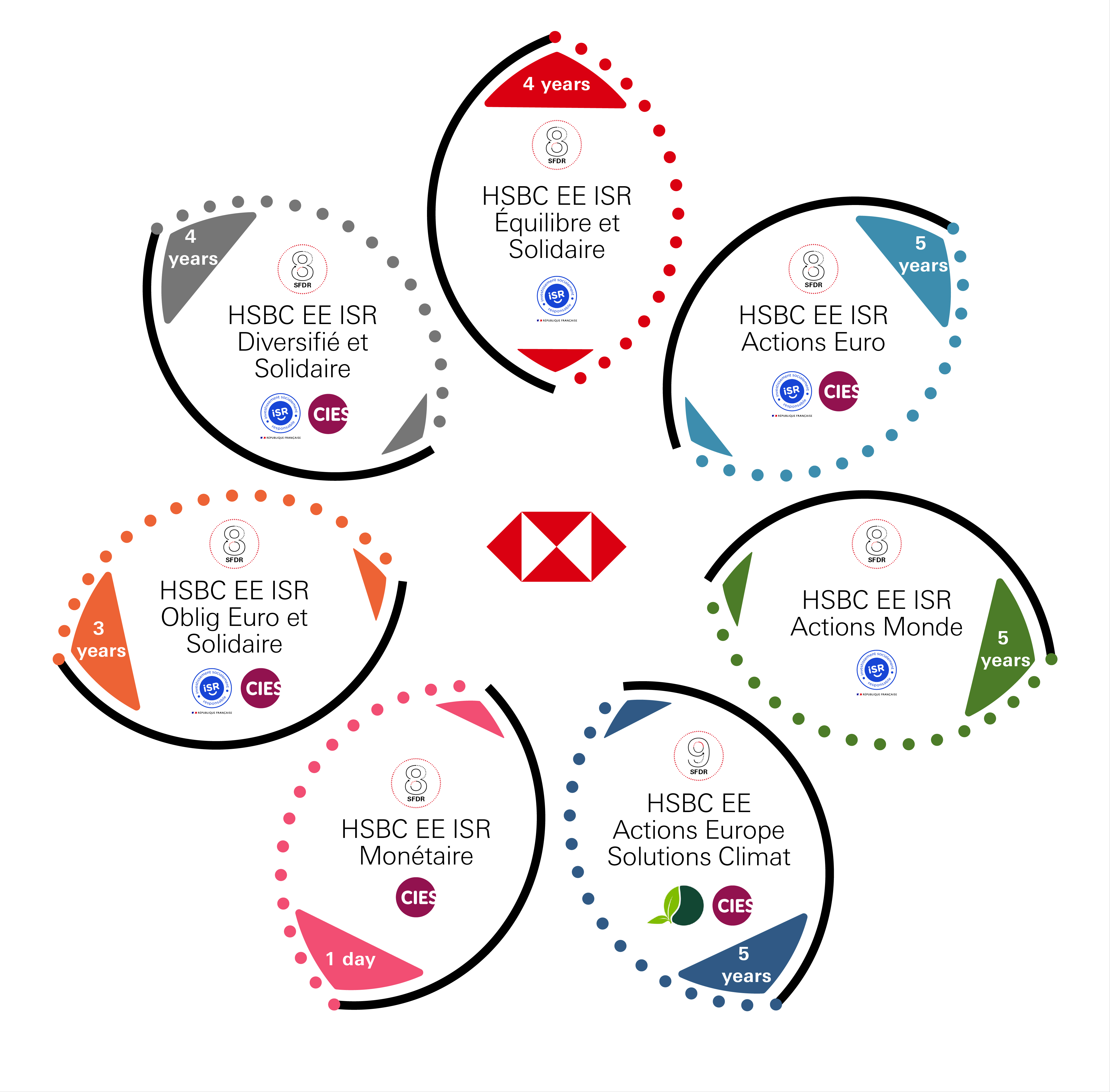
Source: HSBC Asset Management, January 2026. For illustrative purposes only.
Understanding the SFDR regulation and fund classification here.
Key labels as signposts for savers
To give savers clearer guidance amid the wide range of responsible and sustainable investment methodologies, many public and private labels have emerged in France and across Europe. Now essential decision-support tools, they provide savers with transparency and traceability for their investments. Each label has its own set of requirements and a specific, regulated award process.
The ISR label (SRI) |
|
The ISR label, created in 2016 by the French Ministry of the Economy and Finance, provides assurance that a fund meets environmental, social and governance (ESG) criteria. Its aim is to enable savers and professional investors to identify investment funds with a robust socially responsible investment (SRI/ISR) methodology that delivers measurable, tangible results.
The Greenfin label |
|

Created in 2015 by the French Ministry for the Ecological and Inclusive Transition, the Greenfin label guarantees the “green” quality of investment funds and is aimed at financial market participants who act in the public interest through transparent and sustainable practices. A distinctive feature of the label is that it excludes funds that invest in companies operating in the nuclear sector and fossil fuels.
The CIES label |
|

Since 2002, the Inter-Union Committee for Employee Savings (CIES) has awarded its label to employee savings funds that meet its requirements. Asset management companies must ensure that the companies in which employees’ savings are invested stand out for strong social and environmental standards (employee representation, quality of social dialogue, consideration of all stakeholders inside and outside the company, job quality, reducing inequalities, combating discrimination, fighting corruption and tax evasion, and the environmental impact of activities).